

When you're in the property investment space, there's often talk about the importance of timing the market. Essentially, buying in when the market's at the bottom, and riding the wave up to the peak.
But as I've said before many times, property development is different to property investment. Most of the time we're interested in much shorter timeframes to get a project from start to finish.
So does that mean timing the market is irrelevant?
The fact is, timing the market does matter in property development, but the cycle it's based on is different. For investors, it's a price cycle. For developers, it's an activity cycle.
Confused? Let me explain.
A price cycle is fairly clear. Prices rise, they peak, they drop back and languish at the bottom for a while, then they start to rise again. There can be multiple different price cycles happening in one market.
For example, commentators often talk about the "Australian property market" or the "Brisbane property market". But realistically, price cycles happen at least at suburb level, sometimes even at street level.
If you want to take advantage of that price cycle as a property investor - or in other words time the market - then being an Area Expert is a huge advantage.
As a property developer, the cycle follows the same pattern of rise, peak, drop and recover. Except rather than just being about price, as an Area Expert you also need to focus on development activity.
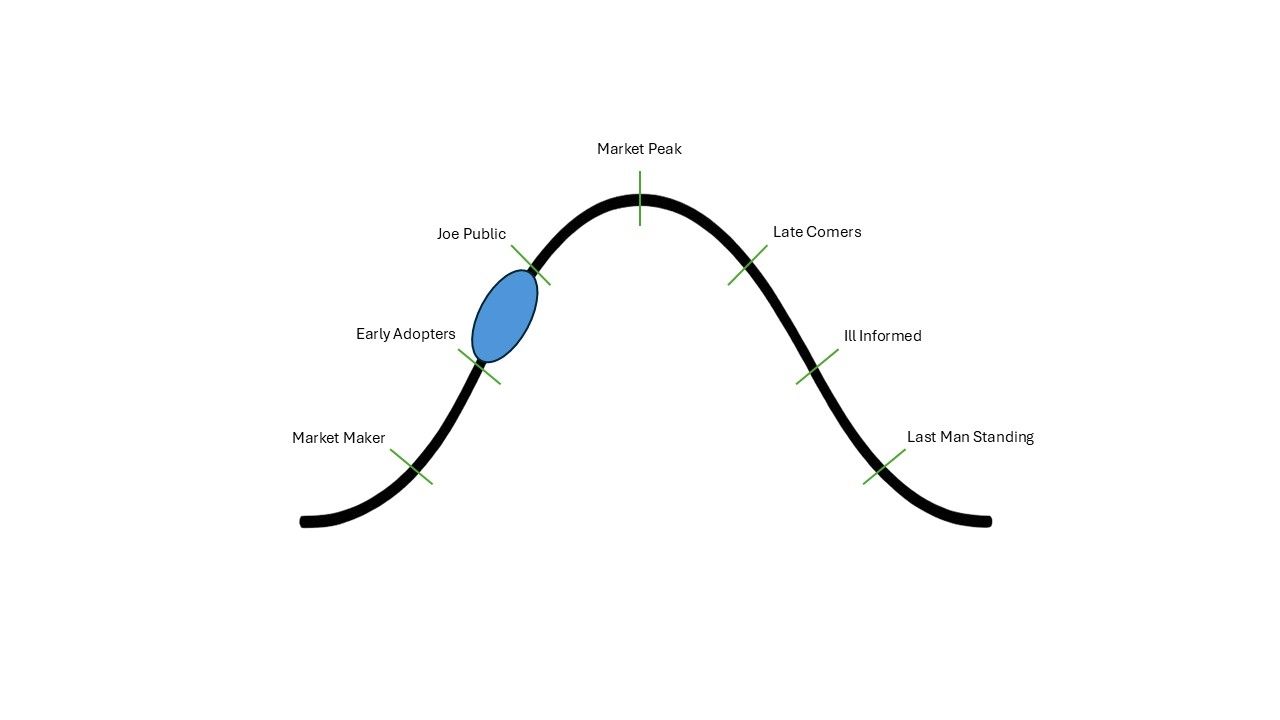
I'll start with an image to show what I mean.
Market Maker
At the very beginning of the curve (where the market is starting to recover) you have the Market Maker phase. At this point, confidence is low, prices may have fallen or stagnated, and media headlines are often negative.
A developer entering the market at this point is essentially flying blind. Nobody else is developing in the area, so finding comparables for end product is difficult - because it doesn't exist.
This is the stage where the bold are rewarded. Land and sites are generally more affordable because competition is thin. Developers who acquire property during the market maker phase can benefit from lower entry prices and have time to plan and obtain approvals before competition arrives.
Sounds great, right? Except that being a market maker is risky. What if you make a market that never takes off? Maybe the market doesn't exist because nobody's interested in the product you're developing?
I'm not going to lie - market makers live in the realm of high risk, high potential reward. For newbies, this is not where you want to be playing. It's definitely a space for experienced developers, preferably with pockets deep enough to cope if the project doesn't deliver.
Early Adopters
Slowly, demand begins to creep back into the market, often driven by improved affordability, lower interest rates, or a growing population.
A few market makers have started to progress their projects to the point where it's clear there's a keen market and money to be made.
This is where early adopters jump onboard the development train. Evidence of success might still be thin on the ground, but they can see it's there and so they start entering while most people remain cautious.
Once the early adopters move into the market, a trend starts to take shape.
Joe Public
This is the most exciting part of the cycle. Demand surges, driven by rising confidence. Property prices begin to climb quickly, often outpacing construction costs.
This period between early adopters and Joe Public is the “sweet spot” for development. Not only are prices rising, but off-the-plan sales become easier as buyers feel confident. Lenders are also more willing to provide finance when pre-sales can be achieved.
For those savvy developers entering during this stage, the focus is on moving quickly to meet demand before the cycle turns again.
Unfortunately there's also a lot of naive newbies jumping into the market thinking everything that glitters is gold, often paying crazy prices for a site because they mistakenly believe every development makes money.
 Peak
Peak
No boom lasts forever. As the expansion continues, development activity accelerates. More and more projects hit the market as developers chase rising prices. Prices to acquire sites reach a point where the numbers just don't stack up any more.
Eventually, new supply begins to outpace demand, and price growth stalls, even as construction pipelines remain full.
This stage requires caution. Margins are thinner, competition is tougher, and buyers become more selective. Developers who rely on strong capital growth to achieve profits may find their numbers squeezed.
The most successful players differentiate themselves with quality, location, or innovative design. Essentially, peak market is not the best time to launch a project unless there is a very clear niche demand. However, well-timed projects that are already under construction can still achieve sales if marketed effectively.
Late Comers
Eventually, the oversupply weighs heavily on the market. Properties take longer to sell, values begin to fall, and confidence evaporates. Media coverage is once again negative, and many developers shelve or cancel projects.
Ill Informed
The downturn continues. By now, every man and his dog is talking about property development and spruiking the advantages. The problem is, they've missed the boat. New entrants to the market are likely to lose money on their projects.
Eventually, you're left with the...
 Last Man Standing
You don't want to be this developer.
One thing that's consistent throughout the cycle is activity. The difference is that on the way up, activity most likely results in profit. On the way down, the late comers might just manage to break even. After that, the losses kick in.
While the last man standing stage feels the most painful, it can also create some of the best buying opportunities. Distressed sales, unfinished projects, and sites bought at inflated prices often come back on the market at a discount. Developers with strong cash reserves or access to finance can position themselves to acquire assets at bargain prices.
However, launching a project during a downturn is high-risk, as demand is weak and buyers are hesitant. This stage is best for patient players who can buy, hold, and wait for the next recovery. Essentially you're going to be in the position of market maker if you launch a project too soon.
The beauty and the challenge of the property development market is that this cycle repeats. After the market bottoms out, supply eventually shrinks as construction stalls. Demand catches up, prices stabilise, and the market moves back into recovery. From there, expansion begins anew.
So for property developers, aligning a project with the right stage of the market cycle is as important as the design or the site itself. Timing can make or break profitability.
By understanding where the market sits in the development cycle, developers can make informed decisions rather than relying on gut feel or chasing headlines.
Each phase brings its own risks and opportunities, and those who understand the signals are better equipped to act decisively.
For developers, the key is not to fear the cycle but to work with it. Done well, this approach transforms market volatility from a threat into a powerful advantage.
In property, as in life, timing really is everything.
But as I've said before many times, property development is different to property investment. Most of the time we're interested in much shorter timeframes to get a project from start to finish.
So does that mean timing the market is irrelevant?
The fact is, timing the market does matter in property development, but the cycle it's based on is different. For investors, it's a price cycle. For developers, it's an activity cycle.
Confused? Let me explain.
A price cycle is fairly clear. Prices rise, they peak, they drop back and languish at the bottom for a while, then they start to rise again. There can be multiple different price cycles happening in one market.
For example, commentators often talk about the "Australian property market" or the "Brisbane property market". But realistically, price cycles happen at least at suburb level, sometimes even at street level.
If you want to take advantage of that price cycle as a property investor - or in other words time the market - then being an Area Expert is a huge advantage.
As a property developer, the cycle follows the same pattern of rise, peak, drop and recover. Except rather than just being about price, as an Area Expert you also need to focus on development activity.
I'll start with an image to show what I mean.
Market Maker
At the very beginning of the curve (where the market is starting to recover) you have the Market Maker phase. At this point, confidence is low, prices may have fallen or stagnated, and media headlines are often negative.
A developer entering the market at this point is essentially flying blind. Nobody else is developing in the area, so finding comparables for end product is difficult - because it doesn't exist.
This is the stage where the bold are rewarded. Land and sites are generally more affordable because competition is thin. Developers who acquire property during the market maker phase can benefit from lower entry prices and have time to plan and obtain approvals before competition arrives.
Sounds great, right? Except that being a market maker is risky. What if you make a market that never takes off? Maybe the market doesn't exist because nobody's interested in the product you're developing?
I'm not going to lie - market makers live in the realm of high risk, high potential reward. For newbies, this is not where you want to be playing. It's definitely a space for experienced developers, preferably with pockets deep enough to cope if the project doesn't deliver.
Early Adopters
Slowly, demand begins to creep back into the market, often driven by improved affordability, lower interest rates, or a growing population.
A few market makers have started to progress their projects to the point where it's clear there's a keen market and money to be made.
This is where early adopters jump onboard the development train. Evidence of success might still be thin on the ground, but they can see it's there and so they start entering while most people remain cautious.
Once the early adopters move into the market, a trend starts to take shape.
Joe Public
This is the most exciting part of the cycle. Demand surges, driven by rising confidence. Property prices begin to climb quickly, often outpacing construction costs.
This period between early adopters and Joe Public is the “sweet spot” for development. Not only are prices rising, but off-the-plan sales become easier as buyers feel confident. Lenders are also more willing to provide finance when pre-sales can be achieved.
For those savvy developers entering during this stage, the focus is on moving quickly to meet demand before the cycle turns again.
Unfortunately there's also a lot of naive newbies jumping into the market thinking everything that glitters is gold, often paying crazy prices for a site because they mistakenly believe every development makes money.
PeakNo boom lasts forever. As the expansion continues, development activity accelerates. More and more projects hit the market as developers chase rising prices. Prices to acquire sites reach a point where the numbers just don't stack up any more.
Eventually, new supply begins to outpace demand, and price growth stalls, even as construction pipelines remain full.
This stage requires caution. Margins are thinner, competition is tougher, and buyers become more selective. Developers who rely on strong capital growth to achieve profits may find their numbers squeezed.
The most successful players differentiate themselves with quality, location, or innovative design. Essentially, peak market is not the best time to launch a project unless there is a very clear niche demand. However, well-timed projects that are already under construction can still achieve sales if marketed effectively.
Late Comers
Eventually, the oversupply weighs heavily on the market. Properties take longer to sell, values begin to fall, and confidence evaporates. Media coverage is once again negative, and many developers shelve or cancel projects.
Ill Informed
The downturn continues. By now, every man and his dog is talking about property development and spruiking the advantages. The problem is, they've missed the boat. New entrants to the market are likely to lose money on their projects.
Eventually, you're left with the...
Last Man StandingYou don't want to be this developer.
One thing that's consistent throughout the cycle is activity. The difference is that on the way up, activity most likely results in profit. On the way down, the late comers might just manage to break even. After that, the losses kick in.
While the last man standing stage feels the most painful, it can also create some of the best buying opportunities. Distressed sales, unfinished projects, and sites bought at inflated prices often come back on the market at a discount. Developers with strong cash reserves or access to finance can position themselves to acquire assets at bargain prices.
However, launching a project during a downturn is high-risk, as demand is weak and buyers are hesitant. This stage is best for patient players who can buy, hold, and wait for the next recovery. Essentially you're going to be in the position of market maker if you launch a project too soon.
The beauty and the challenge of the property development market is that this cycle repeats. After the market bottoms out, supply eventually shrinks as construction stalls. Demand catches up, prices stabilise, and the market moves back into recovery. From there, expansion begins anew.
So for property developers, aligning a project with the right stage of the market cycle is as important as the design or the site itself. Timing can make or break profitability.
- Early stages of recovery: Buy sites, run feasibility studies, and prepare planning approvals.
- As recovery strengthens: Launch projects, market aggressively, and secure finance.
- Peak of the market: Focus on differentiation, control costs, and avoid overextending.
- As the market falls: Acquire distressed opportunities, but avoid speculative builds.
By understanding where the market sits in the development cycle, developers can make informed decisions rather than relying on gut feel or chasing headlines.
Each phase brings its own risks and opportunities, and those who understand the signals are better equipped to act decisively.
For developers, the key is not to fear the cycle but to work with it. Done well, this approach transforms market volatility from a threat into a powerful advantage.
In property, as in life, timing really is everything.