

Nobody has said it better than Warren Buffet:
We want to be greedy when others are fearful and fearful when others are greedy.
Buffet is a business magnate, investor and philanthropist said to have a current worth of around USD$115 billion, so his pithy observations are well worth noting.
Let me tell you what this piece of advice means for you as a Developer.
When property prices plateau and then start to decline, droves of potential Buyers turn their backs on the market. They worry that the market is over-cooked, and that if they buy now and prices decline further they’ll be left with an asset worth less than what they paid.
Conversely, when prices are heading north at an alarming rate, Buyers get scared they’ll miss out on buying their dream home. The dreaded FOMO leads to further price increases as desperate Buyers outbid each other on high-demand properties. This mad stampede of Buyers often coincides with a shortage of stock, creating a true, pressure-cooker market.
What Buffet wants us to be is contrarian: when everyone else is buying, it might be time to sit on your hands for a while. When the Buyers get fearful and put their wallets back in their pocket, Developers should step up and take careful note of what’s available, what fits their strategy, and what price point will make sense, even in a declining market.
You’re probably wondering how you can be certain of which direction the property market is heading at any given time. It’s useful to be familiar with the concept of the Property Clock.
Every property market goes through a cycle; a series of stages that tend to play on repeat.
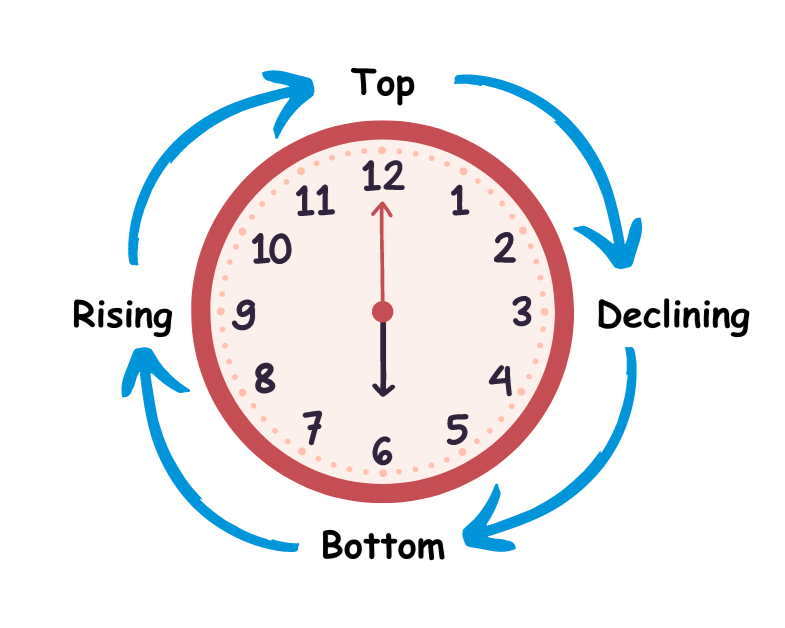
These are the typical stages:
12 o’clock: The peak of a property boom, when prices reach all-time highs and Sellers are reaping the rewards.
3 o’clock: Of course what goes up must come down, and between 12 o’clock and 3 o’clock property prices move away from all-time highs and there may be price falls in some suburbs or regions, particularly if there is an over-supply of property.
6 o’clock: After spending some time in the doldrums, property prices have reached the bottom of the cycle.
9 o’clock: The market is rising again as Buyers outnumber Sellers and pressure on prices intensifies.
There are plenty of commentators who offer their opinion on what time it is on the Property Clock for any given market, but you can use indicators and drivers to make your own assessment.
Read this blog post for a better understanding of how to use readily available data to determine where the property market is at. Your aim is to figure out if you’re in an upswing or a downswing.
As Developers, we need to understand that when there’s a frenzy of Buyers – between 9 o’clock and 12 o’clock – Vendors are happy to negotiate upwards on price, but they probably won’t be interested in negotiating on terms.
On the flipside, when buyer numbers are dwindling – especially between 12 o’clock and 3 o’clock when high prices are still top of mind – Vendors are desperate to hold onto their price points. They’re still in the “greedy” part of the cycle, yet the cycle has moved on and they may realise the only way to lock in their dream price is to negotiate on terms.
I find there’s usually a window of opportunity in the first six to nine months after the 12 o’clock peak of the property cycle that plays in our favour. This is when we can negotiate long settlements, early access or perhaps a joint venture.
But before you start wheeling and dealing, there’s one critical element to consider.
Duration of your project
The length of your project will give you an indication of whether you’re able to buy and sell in the same market, that is, at roughly the same time on the Property Clock, or whether you’ll be buying and selling at two very different times.
For example, if you’ve got a three-month subdivision project, you’ll most likely be in and out of the same market, with prices largely stable. On the other hand, if you’ve got a 24-month townhouse project, you could be buying and selling at opposite ends of the cycle.
The expected duration of your deal will determine at which point on the Property Clock you should aim to buy. Ideally, for longer projects you’ll want to buy in between 12 o’clock and 6 o’clock and sell between 9 o’clock and 12 o’clock.
We can manufacture profit in any market, whether it’s going up, down or sideways, if we know how to read the market.
The difference will be in how we make our property acquisition.
Just remember Buffet’s sage advice.
If everyone else is busting to buy, it may be prudent to sit on the sidelines for a while. And if supply outstrips demand and the market is in a downswing, don’t be afraid of buying in if you believe the market is close to the bottom after you’ve done your market analysis.
We want to be greedy when others are fearful and fearful when others are greedy.
Buffet is a business magnate, investor and philanthropist said to have a current worth of around USD$115 billion, so his pithy observations are well worth noting.
Let me tell you what this piece of advice means for you as a Developer.
When property prices plateau and then start to decline, droves of potential Buyers turn their backs on the market. They worry that the market is over-cooked, and that if they buy now and prices decline further they’ll be left with an asset worth less than what they paid.
Conversely, when prices are heading north at an alarming rate, Buyers get scared they’ll miss out on buying their dream home. The dreaded FOMO leads to further price increases as desperate Buyers outbid each other on high-demand properties. This mad stampede of Buyers often coincides with a shortage of stock, creating a true, pressure-cooker market.
What Buffet wants us to be is contrarian: when everyone else is buying, it might be time to sit on your hands for a while. When the Buyers get fearful and put their wallets back in their pocket, Developers should step up and take careful note of what’s available, what fits their strategy, and what price point will make sense, even in a declining market.
You’re probably wondering how you can be certain of which direction the property market is heading at any given time. It’s useful to be familiar with the concept of the Property Clock.
Every property market goes through a cycle; a series of stages that tend to play on repeat.
These are the typical stages:
12 o’clock: The peak of a property boom, when prices reach all-time highs and Sellers are reaping the rewards.
3 o’clock: Of course what goes up must come down, and between 12 o’clock and 3 o’clock property prices move away from all-time highs and there may be price falls in some suburbs or regions, particularly if there is an over-supply of property.
6 o’clock: After spending some time in the doldrums, property prices have reached the bottom of the cycle.
9 o’clock: The market is rising again as Buyers outnumber Sellers and pressure on prices intensifies.
There are plenty of commentators who offer their opinion on what time it is on the Property Clock for any given market, but you can use indicators and drivers to make your own assessment.
Read this blog post for a better understanding of how to use readily available data to determine where the property market is at. Your aim is to figure out if you’re in an upswing or a downswing.
As Developers, we need to understand that when there’s a frenzy of Buyers – between 9 o’clock and 12 o’clock – Vendors are happy to negotiate upwards on price, but they probably won’t be interested in negotiating on terms.
On the flipside, when buyer numbers are dwindling – especially between 12 o’clock and 3 o’clock when high prices are still top of mind – Vendors are desperate to hold onto their price points. They’re still in the “greedy” part of the cycle, yet the cycle has moved on and they may realise the only way to lock in their dream price is to negotiate on terms.
I find there’s usually a window of opportunity in the first six to nine months after the 12 o’clock peak of the property cycle that plays in our favour. This is when we can negotiate long settlements, early access or perhaps a joint venture.
But before you start wheeling and dealing, there’s one critical element to consider.
Duration of your project
The length of your project will give you an indication of whether you’re able to buy and sell in the same market, that is, at roughly the same time on the Property Clock, or whether you’ll be buying and selling at two very different times.
For example, if you’ve got a three-month subdivision project, you’ll most likely be in and out of the same market, with prices largely stable. On the other hand, if you’ve got a 24-month townhouse project, you could be buying and selling at opposite ends of the cycle.
The expected duration of your deal will determine at which point on the Property Clock you should aim to buy. Ideally, for longer projects you’ll want to buy in between 12 o’clock and 6 o’clock and sell between 9 o’clock and 12 o’clock.
We can manufacture profit in any market, whether it’s going up, down or sideways, if we know how to read the market.
The difference will be in how we make our property acquisition.
Just remember Buffet’s sage advice.
If everyone else is busting to buy, it may be prudent to sit on the sidelines for a while. And if supply outstrips demand and the market is in a downswing, don’t be afraid of buying in if you believe the market is close to the bottom after you’ve done your market analysis.